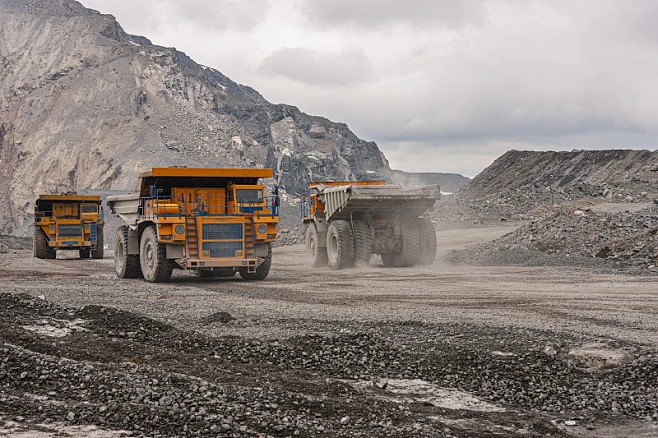
In continuously operating environments such as mines, quarries and ports, every hour of machine downtime is a direct loss. And the high-pressure hose is exactly the kind of component nobody watches — unlike an engine with instrumentation, or a tyre whose wear you can see at a glance.
Understanding why hoses fail matters more than memorising a replacement interval.
1. Five failure modes, five root causesHose burst. The most serious. Usually caused by sustained overpressure (especially unrecorded pressure spikes), accumulated impulse fatigue, or selecting a hose against burst pressure instead of working pressure.
Coupling leakage or pull-off. The most frequent failure in the field. Usually related to the crimping process: under-crimping gives insufficient grip, while over-crimping damages the wire reinforcement. Mismatched hose and coupling ratings, or torsional load from a twisted installation, also cut service life sharply.
Cover abrasion and cuts. When a hose rubs against a frame, an edge or another hose over time, the cover wears through and the wire reinforcement is exposed — corrosion and wire breakage follow quickly. This is the failure that seems least likely yet is most often ignored; a protective sleeve usually solves it.
Age cracking. The combined result of ozone, UV and heat. Once fine surface cracks appear, performance has typically already degraded and failure may be close.
Insufficient bend radius and twisted installation. Problems planted at installation. Below the specified bend radius, local stress concentration rises and impulse life drops noticeably; a twisted installation (hose axis not perpendicular to the plane of bending) puts additional torque on the coupling.
Why impulse performance is the key metricHydraulic systems on construction machinery see thousands of pressure cycles every day. Even when each cycle is far below burst pressure, after hundreds of thousands of cycles the wire reinforcement can fatigue and break.That is why the impulse test is considered the validation method closest to real operating conditions.
Measured impulse data from a supplier tells you more than any nominal pressure figure.3. Maintenance: three things to look at, two reasons to replace
Look at the surface: blisters, cracks, cuts or swelling on the cover; oil weeping, corrosion or deformation at the coupling.
Look at the installation: bend radius within specification, no twist, stretch or interference with moving parts, clamps present and tight.
Look at changing conditions: unexplained pressure increases, persistently high oil temperature (roughly, every 10°C rise in oil temperature doubles the ageing rate of rubber).
Replace at end of life: when the manufacturer's service time or cycle limit is reached — not "when it breaks".
Replace immediately on any anomaly: swelling, cracks reaching the reinforcement, coupling leakage, or cover worn through to bare wire. None of these are watch items; all require immediate replacement.
Six rules for selection and installation
Select against peak pressure, with a safety factor of 4:1 or higher.
Take the lowest of hose, coupling and crimp ratings.
In cold climates, check cold-bend performance (e.g. no cracking at -40°C).
For high-impulse duty, favour products with thorough impulse-life data.Maintain bend radius and use proper clamps; avoid twisted routing.
Fit protective sleeves at abrasion points — minimal cost, high return.