

A ultra-high-pressure hose assembly line rated for long-term service at −50 ℃, targeting cold-region mines, onshore and offshore wind, permafrost and polar engineering, and refrigerated logistics equipment. It addresses a pain point many specs overlook: the same 4SP hose that bends at 25 ℃ may still install at −40 ℃, but at −50 ℃ it turns rigid like a steel bar — won't route, won't bend, and cracks on first use.
What Low Temperature Actually Kills in a Hose
Low temperature poses two threats to a hose. The first is the rubber glass transition: conventional inner and cover compounds shift from rubbery to glassy state near their glass transition temperature (Tg), losing elasticity so abruptly that even light bending leaves white marks or micro-cracks. The second is reinforcement flexibility: as the rubber stiffens, the steel-wire spiral structure gains overall rigidity and its effective minimum bend radius grows, so equipment with tight routing space simply cannot be plumbed. The more hidden threat is impulse life — low temperature raises material brittleness, and crack growth under the same impulse load is far faster than at room temperature. A design that is "good enough" at ambient can fail early in the cold.
Four Low-Temperature Core Technologies
① Low-Tg elastomer formulation. Inner tube and cover use low-temperature elastomers with matched plasticizers, keeping glass transition below −55 ℃ so the hose stays highly elastic at −50 ℃ and resists brittle behavior under bending and impulse loads.
② Verified low-temperature impulse life. Assemblies are impulse-tested at near-service low media temperatures (−46 ℃ to −50 ℃) rather than only at ambient, so "low-temperature impulse life" is a measured figure, not an extrapolation.
③ Low-temperature flexible reinforcement. Optimized wire winding layout and cover thickness hold rated working pressure while lowering the combined cold stiffness, keeping the minimum bend radius routable in cold conditions.
④ Weather-resistant cover. Ozone- and UV-resistant cover compounds address exposed wind turbine nacelles and high-altitude ultraviolet exposure, slowing cover cracking and aging.
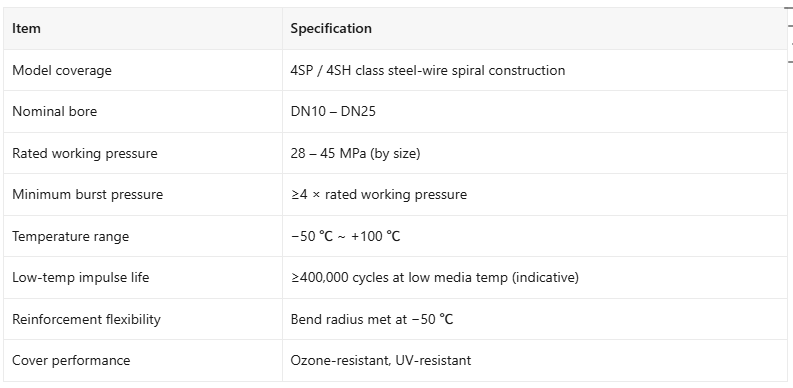
Key Specifications (Indicative)
Typical Applications
Wind turbine pitch and yaw hydraulic systems, onshore/offshore wind farm maintenance, cold-region mine trucks and drills, permafrost and polar engineering equipment, refrigerated logistics tail lifts and dock levelers.
Related: arctic rated hydraulic hose