
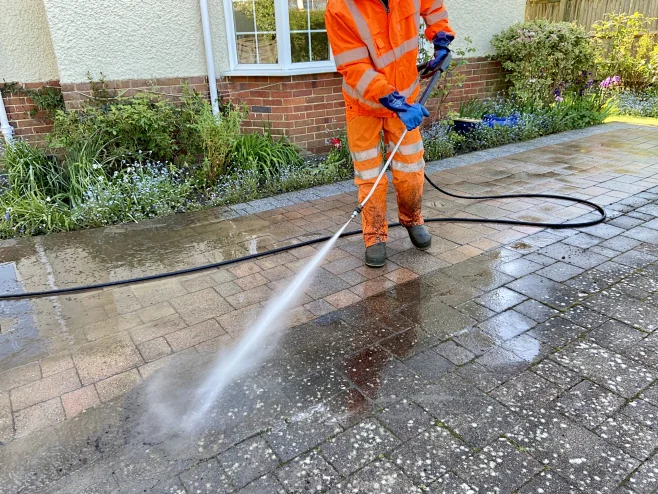
Ultra-high-pressure water jetting — cleaning, cutting, surface preparation, and demoulding — concentrates enormous energy in a small package. The hose that carries that pressure is the component operators touch most and inspect least. When a water jet hose fails, it fails violently: a ruptured 2800-bar hose releases enough energy to cause serious injury, and the failure usually happens at the fitting or at a bend, not in the middle of a straight run.
This guide explains how UHP water jet hoses are constructed, why they fail, and how to build an inspection routine that catches problems before the hose makes the decision for you.
1. What makes a UHP hose different
A standard industrial hydraulic hose is not a water jet hose. Ultra-high-pressure service changes three things:
The construction. UHP hoses typically use a wire-braided or wire-spiral reinforcement sized for 2000–4000 bar working pressure, with a burst margin built in. The reinforcement must be continuous and undamaged along the full length — a single cut wire in one braid layer reduces the burst pressure of the whole assembly.
The tube compound. Water at extreme pressure is not chemically aggressive, but the tube must resist the erosion of entrained particles and the fatigue of constant pressure cycling. Tube compounds for UHP service are formulated for abrasion resistance and long fatigue life, not for oil resistance.
The fittings and crimp. Most UHP hose failures happen at or near the fitting. The crimp must be made to the fitting manufacturer’s specification, with the correct die, the correct insertion depth, and controlled crimp diameter. A hose crimped to a “close enough” dimension is a hose with an unknown burst pressure.
Because of these differences, mixing a UHP hose with standard fittings — or using a UHP hose beyond its rated cycles — is one of the most common and most dangerous shortcut in water jetting operations.
2. Why UHP hoses fail
Understanding the failure modes tells you where to look during inspection:
Fatigue at bends. Every pressure pulse flexes the hose. Flexing concentrates at bends, so a hose routed through a tight bend accumulates fatigue damage far faster than a straight run. This damage is invisible from outside until the reinforcement wires start breaking.
Abrasion. Dragging a UHP hose across concrete, steel decking, or a truck bed removes cover material and then wire. A hose whose reinforcement has been abraded through even one layer has lost a large fraction of its burst pressure.
Kinking. Running over a hose with equipment, or pulling it around a corner by one end, kinks the reinforcement into a permanent weak point. A kinked UHP hose should be removed from service immediately, not “watched”.
Fitting problems. Incorrect crimp dimension, wrong fitting for the hose, corrosion under the fitting, or a hose that has been pulled out of its crimp by half a millimetre — all show as leakage or movement at the connection, and all precede catastrophic failure.
Chemical and thermal ageing. The cover compound ages with UV exposure, heat, and chemical contact. Age hardens the cover, which then cracks, exposing the reinforcement to corrosion. Corroded wire loses strength silently.
Exceeding service life. Even a perfectly maintained UHP hose has a service life. Pressure cycling is cumulative. The industry practice is to retire hoses on a schedule based on operating hours and cycles, not on appearance.
3. The inspection routine
A practical UHP hose inspection programme has three levels.
Every use, before pressurising
- Run the full length through a gloved hand and look for cuts, abrasion, kinks, or exposed wire.
- Check both fittings for leakage, corrosion, or any sign of movement at the crimp.
- Confirm routing: no bends below the minimum radius, no hose under tension, nothing pressing on it.
Weekly, in a documented check
- Examine bend areas and the last 300 mm at each fitting closely — this is where fatigue and fitting damage concentrate.
- Look for cover cracking, particularly on the sun-exposed side of hoses stored outdoors.
- Check for permanent deformation: a hose that no longer lies straight has internal damage.
- Record hose ID and reading. The log is what lets you see a trend instead of a snapshot.
Periodically, by competent personnel
- Hydrostatic or proof-pressure testing to the hose manufacturer’s procedure for hoses in critical service.
- Verification against the retirement schedule.
- Review of incident logs — near-misses and leaks are the cheapest failure data you will ever collect.
4. Retirement rules that actually get followed
Inspection only works if there is a clear retirement rule that operators can apply without judgement calls. Set these in writing:
1. Any exposed reinforcement wire — retire. Not patch, not monitor: retire.
2. Any kink or permanent set — retire.
3. Any fitting leakage or movement — retire the assembly; do not re-crimp and reuse.
4. Abrasion through the cover to the reinforcement — retire.
5. Cover cracking, splitting, or hardening — retire.
6. Time or cycle limit reached — retire, regardless of appearance.
7. Unknown history — a hose whose service record is missing is a hose with unknown remaining life. Retire or test it before use.
The discipline that matters most is number 7. Most serious UHP incidents involve a hose whose history nobody could reconstruct.
5. Operating practices that extend life
Control the pressure cycling. Ramp pressure smoothly where the application allows; avoid repeated pressure spikes that hammer the reinforcement. Some operations halve hose life purely through how the trigger is used.
Manage the whip and recoil. A UHP hose under pressure is a loaded spring. Use hose restraint systems and never stand in line with a pressurised hose or fitting.
Protect during transport and storage. Coil without kinks, store off the ground, cap the ends, keep out of direct sunlight, and label every hose with its service start date so the retirement clock is visible to everyone.
Train the operator, not just the technician. The person holding the jet lance sees the hose in operation every day. Teach them the five visible retirement conditions and give them explicit authority to stop work — without discussion — when they see one.
6. Summary
Ultra-high-pressure water jet hoses reward discipline and punish shortcuts. The construction must match the pressure class, the crimp must match the specification, the routing must respect the bend radius, and the retirement rules must be written down and enforced without exceptions.
The cost of a UHP hose is trivial compared with the cost of a failure. Build the log, train the operators, and replace on schedule — the hose that gets retired on time is the one that never has an incident.
Related products and reading
- Ultra-high-pressure cleaning hose — for sustained high-pressure jetting duty
- Steel wire reinforced high-pressure resin hose — reinforced construction for demanding pressure classes
- Related guide: Crimping failure modes and QC — the connection is where most failures start
YIBO Tech manufactures ultra-high-pressure water jet and cleaning hoses engineered for sustained high-pressure service, with matching fitting and crimp specifications. Contact our team for pressure class, length, and fitting recommendations for your jetting application.
Related: water jet hose rated to 4000 psi